What to put on an invoice so you get paid on time
The details every invoice needs, the payment terms that get money in sooner, the small mistakes that delay it, and a calm routine for chasing late payers.

Edema Ukabi, ToolkitDeck Team
· 6 min read
Key points
- An invoice gets paid fastest when the client can see what it is for, how much, by when and how to pay, without asking you anything.
- Give a real due date, such as 'Due 31 March', rather than 'Net 30' or 'due on receipt'.
- Shorter terms, such as 7 or 14 days, usually bring money in sooner than 30.
- Put your bank details or payment link on the invoice itself.
- Never edit an invoice you have sent. Void it and issue a corrected one with a new number.
- Agree your terms and your chasing routine before the work starts, then follow it calmly.
You did the work. The client was happy. Then the invoice sits unpaid for six weeks, and you are chasing someone you would rather be thanking.
Most late payments aren't about money. They happen because the invoice was missing a purchase order number, nobody could tell when it was due, or the person paying had to hunt for your account details. Every one of those is fixable before you send it out.
This guide covers exactly what to put on an invoice, the payment terms that get money in sooner, the small mistakes that slow it down, and a routine for chasing late payers without souring the relationship.
What should an invoice include?
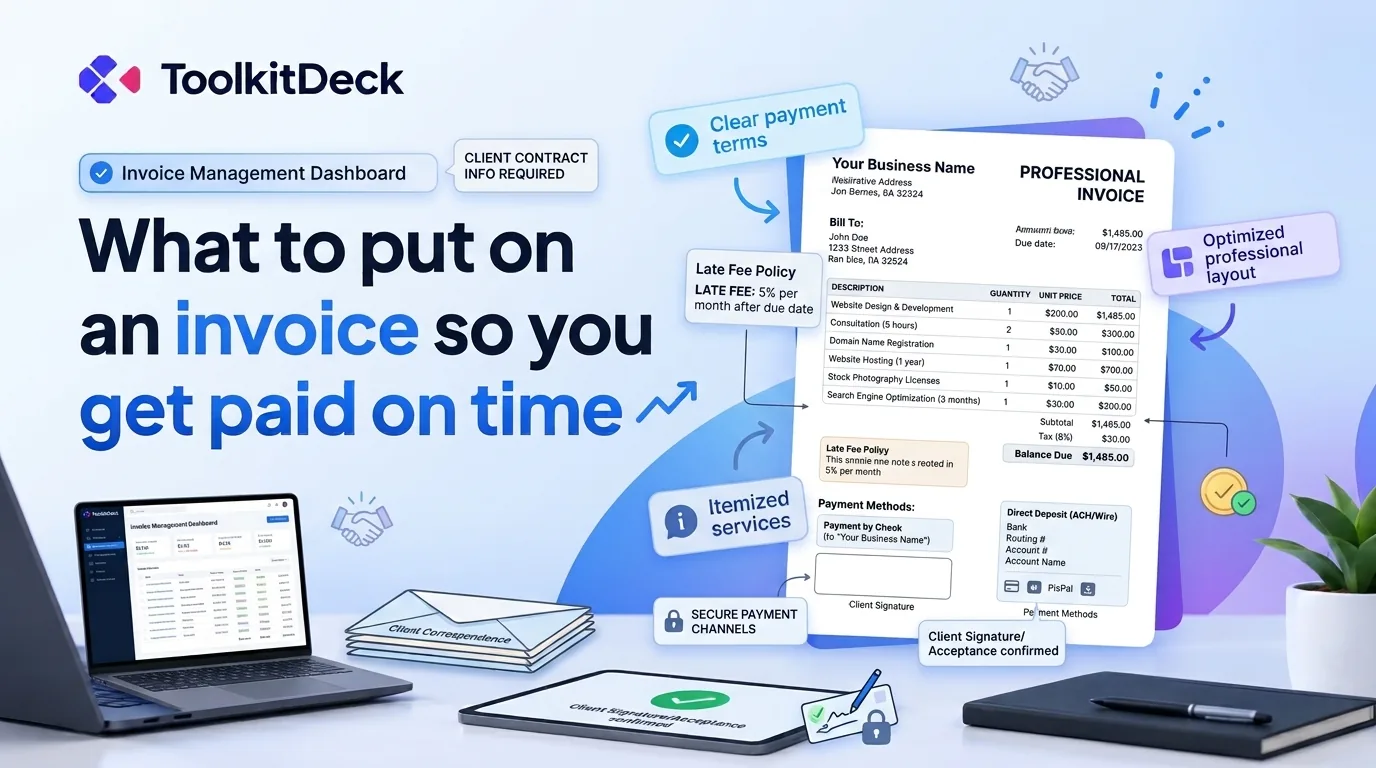
An invoice should let the person paying it act without asking you a single question. Whatever country you work in, include:
The word "Invoice" and a unique number. Numbers should run in order and never repeat. Your accountant, and in many countries the tax office, will expect that.
Your business name, address and contact details, plus your tax or registration number if you have one.
Your client's name and address, written the way their accounts team knows them. Add their purchase order number if they gave you one.
The issue date and the due date. These are two different things, and both matter.
What you are charging for: one line per item, with a quantity, a unit price and a line total.
Discounts and tax shown separately, such as VAT or sales tax, with the rate.
The total due, in one clear figure, with the currency.
How to pay you: your bank name, account name and number, or a payment link.
Your payment terms, in one sentence: "Payment is due within 14 days of the invoice date."
An example of clear invoice lines
Description | Qty | Price | Total |
|---|---|---|---|
Logo design, three concepts and two rounds of changes | 1 | 150,000 | 150,000 |
Business cards, 500, printed and delivered | 2 | 25,000 | 50,000 |
VAT at 7.5% | 15,000 | ||
Total due by 14 March | 215,000 |
Anyone in the client's accounts team can see what each charge is for and what to pay.
Which payment terms get you paid fastest?
Short, specific terms work best. Instead of "Net 30" or "Payable on receipt", write a date: "Due 14 March". A date gives the client something to plan around and gives you a clear day to follow up.
Many freelancers and small businesses find that asking for payment within 7 to 14 days brings money in sooner than 30-day terms. FreshBooks, which looked at more than a million small-business invoices, recommends that range. Long terms tend to get longer in practice, because 30 days becomes "the next payment run after 30 days".
For bigger jobs, consider asking for a deposit before you start, such as 30 to 50 percent, with the balance on delivery. It protects your cash flow and confirms the client is serious.
What about late fees?
In some countries the law lets you charge interest on late business payments even if you didn't agree it in advance. In the UK, for example, a business can claim statutory interest of 8% above the Bank of England base rate on late business-to-business payments. Elsewhere, any late fee should be in your terms before the work starts. Check what applies where you are, and use it as a last resort rather than an opening move.
What small mistakes delay payment?
No due date. "Payable on receipt" often means "whenever we get round to it".
Payment details in a different place. If your account number is in an email from three weeks ago, the payer has to go and find it.
A total that doesn't match what they will pay. If a company client deducts withholding tax, show it on the invoice so the amount due is what will actually arrive. Otherwise their payment looks short and someone has to sort it out by hand.
Sending it late. The best day to invoice is the day the work is delivered, while its value is fresh.
Sending it to the wrong person. Ask at the start who approves invoices and who pays them. They are often different people.
Should you send a quote first?
For anything bigger than a small one-off job, yes. A quote that the client accepts in writing means you both agree on the price before the work begins. When the work is done, turning the accepted quote into an invoice takes seconds and leaves nothing to argue about.
Can you change an invoice after sending it?
No. Once an invoice is sent, keep it exactly as it was. If you spot a mistake, void it, issue a corrected invoice with a new number, and tell the client which one to pay. Records that change after the fact cause real trouble at the end of the year, with your accountant and with the tax office.
How do you chase a late invoice without being awkward?
Chasing is easier when it is a routine rather than a decision you make while annoyed. A simple one:
Three days before the due date: a friendly note. "Just a reminder that invoice 104 is due on Friday. Thanks again for the work."
On the due date, if nothing has arrived: resend the invoice with your payment details.
A week late: a short, direct reminder with the amount and the date it was due.
Two weeks late: call. A conversation often uncovers the real problem, such as a missing approval.
After that: pause further work until the account is settled, as your terms said.
The last step only works if it was in your terms from the start. A line in every quote, such as "Invoices are due within 14 days; work pauses on overdue accounts", makes every reminder feel like a normal part of doing business, not a confrontation.
A checklist before you send
Invoice number, in sequence
Issue date and a real due date
Client's correct name and purchase order number
One clear line per item
Tax and discounts shown separately
Total due, with currency
Bank details or payment link
Your terms in one sentence
Common questions
What is the difference between a quote, an invoice and a receipt?
A quote is the price you offer before the work. An invoice asks for payment once the work is done or agreed. A receipt confirms you have been paid. Keeping all three numbered and linked makes your records easy to follow.
Do I need a registered business to send an invoice?
In most countries, no. A freelancer or sole trader can invoice in their own name. Once you register for tax, such as VAT, your invoices usually have to show your tax number and the tax charged.
How long should payment terms be?
Short and specific. Seven or 14 days suits most freelancers and small businesses. Large companies sometimes insist on 30 days or more. If so, agree it up front and invoice on the first day you can.
Can I ask for payment before I start?
Yes. A deposit, or full payment up front for small jobs, is common and reasonable. Put it in your quote so the client agrees to it before any work begins.
What if the client deducts withholding tax?
Show the deduction on the invoice so the "amount due" matches what will actually be paid, and ask the client for the tax credit note or receipt afterwards. You will need it for your own tax return.
Send your next invoice in minutes
You don't need accounting software to send a proper invoice. You need a template with everything above, numbering that takes care of itself, and a way to see who has paid. ToolkitDeck's invoice generator gives you quotes your client accepts from a link, invoices numbered automatically with tax worked out, your bank details on every one and, on paid plans, email reminders that chase late invoices for you. The money goes straight to you. We never handle it.
If you also need to know where the money goes once it arrives, see how to turn a bank statement into a spreadsheet you can trust.